
A New Moon

Alhamdulillah, last new moon as we entered Rabi’ al-Thani 1444 a new moon was born. We had a baby girl half past noon and we named her Zahra. Commonly translated as ‘flower’, it also means the exquisite and illuminated one. It was my first home birth and it reminded me of my second birth experience in many ways, from the fact that they were both born on a new moon, the general feelings around the pregnancy especially towards the end, length of pregnancy and how my labor started, how long labor lasted and the very intense, overpowering fetal ejection reflex (which was not as overwhelming with my other two daughters). Of course, this birth was a lot more hands-off having taken place at home (I recognize that’s not always the case even at home births), with no routine protocols set in place. I very much liked and enjoyed my midwife’s company during my pregnancy and while that did not guarantee that I would feel the same way at birth, I really appreciated her demeanor and support at birth too. After birth, everything went as smoothly as I could have wished for. The kids were ecstatic and they’ve been in love since.
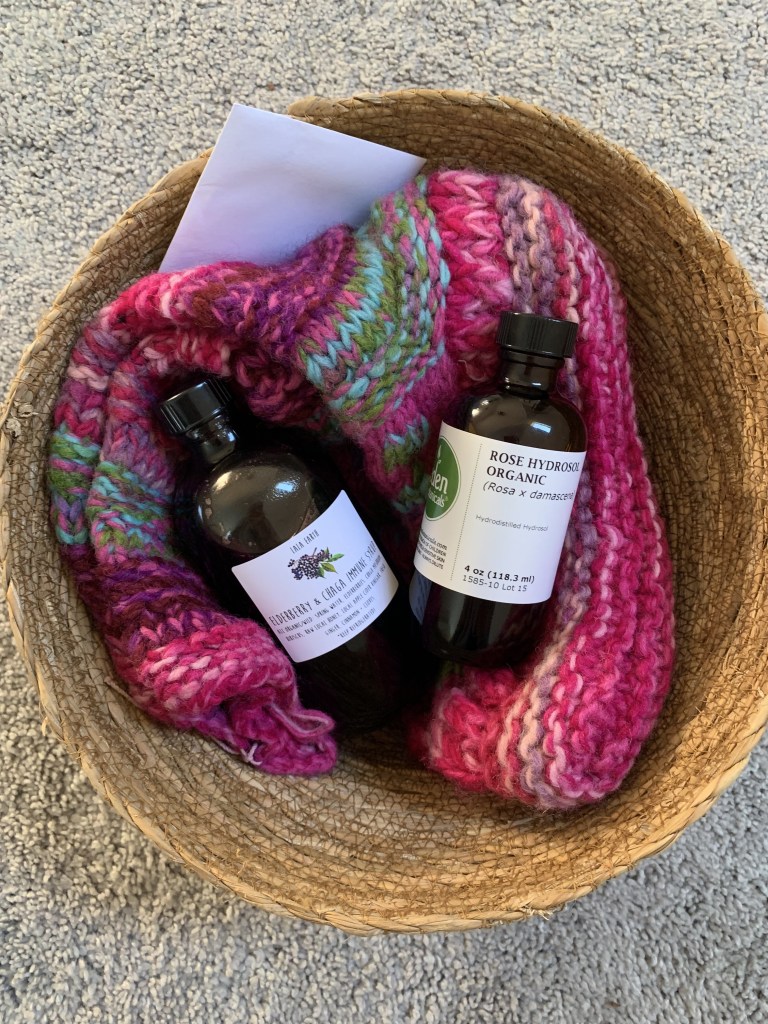
Gift basket for my midwife

As this pregnancy was the most I’ve been away from my family, with only one visit from my sister who had to leave before the birth, I really craved being cared for, something as simple as my mom or my grandmother making me a warming stew. I felt a void and yearned for a somewhat motherly nurturing. This might have been why I didn’t even want to meet a much younger midwife in my area after having met my much older midwife initially. It is also why I so appreciated the compassion I felt from a much older Ayurvedic postpartum doula and massage therapist whom I saw several times for prenatal massage. I almost felt bad getting that care from her and asked her once who cares for her. She said that she feels cared for by caring for others, and that when she gives a massage she has to remain as calm and grounded in her body as possible because tension in her body would translate to more tension in her client’s body.

While it’s been stressful in some ways, realistically speaking, it has also been a smooth transition overall and I have also gained a new appreciation for my husband. While this is not our first child and he’s always been there for each immediate postpartum period (with varying lengths), this is a new experience for him in that he’s had to take on a lot more responsibilities with no one else present to take them on. We also hired a traditional postpartum doula, a wonderful Mexican woman, for 4 days in the first week following birth. That was an invaluable investment and I would have hired her for even more days if it were feasible.

In the meantime I haven’t left the house in 2 weeks and I don’t plan to leave for as many days as possible in the first 40 days, especially not to go grocery shopping. While I miss taking the older kids out myself and getting on with my life as normal, I know that once this sensitive period is over I will be back at it inshaa Allah, so there’s no rush…
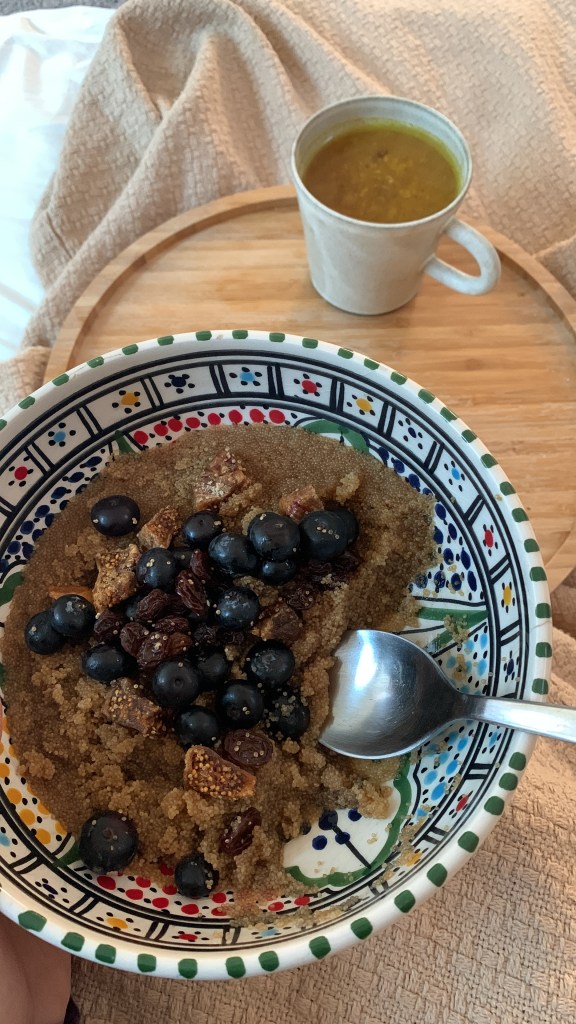
Breakfast in bed
(amaranth porridge with fruit & golden milk made with coconut milk & chopped walnuts, prepared by my postpartum doula)
Journey to Pregnancy

I didn’t have a particular issue with fertility but I wanted to share some of the things I learned ever since I got concerned with having a baby.

TMI warning in advance.

IMG_3116

Nearly two years ago, I conceived my first baby girl Zaynab. We had been married for a year and a half, and having been one of these women who almost always had a regular menstrual cycle, I found my cycle to change dramatically and never go back to normal right after getting married. My cycles seemed to be longer, and I just never knew how long or short each one would be anymore. No cycle was the same as the previous or next one again. Once I noticed this change, I downloaded a period calendar app to keep track. I also didn’t know anything about fertile mucus, ovulation and so on until after I got married. I thought getting pregnant was a lot easier, just join the two cells any time of the month excluding the days of menstrual flow; but no!

My husband and I weren’t living together for the first 15 months of our marriage, until I finally got my green card and was able to join him in the US. In the meanwhile, he did visit every couple of months for a few days but I still never got pregnant. I experienced three other cycles before I would conceive after my move. I got my first period shortly after the move. I do remember having menstrual camps around the second day, which was typical for me, for a few hours.

After that, I discovered a practice called bajos, which are vaginal steam baths. This practice is found in a lot of different cultures across the world, but I particularly came across an article by Dr Rosita Arvigo. Without wasting much time, I prepared a steam bath using some herbs from my garden and from my herbal apothecary. I did this first bath at the peak end of my second period. I also noticed that this second cycle and eventually third cycle were shorter than my usual cycles for the last few months, and they were also about the same in length, lasting approximately 29 days. God knows best, but I attributed that to healthier eating as I was buying more organic, wholesome foods after moving into my own home, or eating less meat, which maybe didn’t have to do with less meat in general but rather less meat that was full of hormones. I still ate dairy but only organic.

Then I did some more research on some of the practices that Dr Arvigo advocates for, and found out about Mayan Abdominal Therapy. Luckily, I found a practitioner nearby and made an appointment to see her. At our appointment, I first filled out some personal information, followed by a discussion mostly about my reproductive health, and then finally, I was taught how to perform the abdominal therapy on myself.

One thing I remember mentioning to her during the appointment was that I never notice that fertile, stretchy, egg-white, cervical mucus. She told me that having a period doesn’t necessitate successful ovulation. She also told me she felt that my uterus was a little tilted to the right. The Mayan abdominal therapy would help lift the uterus and realign it. Other benefits would be undoing tight knots in the abdominal area, and encouraging improved blood and lymph flow. The practitioner told me it’d be best if I did this therapy every day, excluding a few days before the predicted start of my cycle, and the days of menstrual flow.  So I stuck with it.

I did a second steam bath at the peak start of my third and final cycle. Sure enough, this time I didn’t experience any cramping. A few days after the end of my cycle, I felt a tiny pinch on the lower right side of my abdomen. When I went to the bathroom a little later, I noticed blood-tinted, thick clear mucus. This egg-white mucus continued for a couple of more days. I wrote my practitioner telling her about my experience, and I wondered if that pinch I felt was ovulation, followed by a little bit of ovulation spotting.

My fourth period never came and I got my positive pregnancy test on the evening of August 9th, 2015. My estimated due date was April 14th, 2016. I went into labor April 12th, and gave birth on April 14th at 2.15am.

Links:

Vaginal Steams | Forgotten Ancient Wisdom for Women’s Healing

Vaginal Steams | Alignment Monkey

Arvigo Techniques of Maya Abdominal Therapy

Week One of Ramadan 2017

We are already on day 8 of this year’s Islamic lunar month of Ramadan. Before I get to the real purpose of my post which is sharing how my experience has been fasting while pregnant for the first time, I would like to write a little about what Ramadan is about. Even if you’re not a Muslim, you have likely heard of this holy month that is welcomed by most Muslims with much joy. The month of Ramadan is when the first verses of the Qur’an were revealed to the final Prophet of Islam, Muhammad ﷺ. During Ramadan, Muslims observe the fast incumbent upon every Muslim who has reached the age of accountability, and who is physically able to do so. The fast begins at what they call true dawn which is the Fajr prayer time, before sunrise, and ends at sunset (Maghrib prayer time). There are two other prayer times in-between Fajr and Maghrib. The fast excludes all liquids and solids, including water. Obviously the days are shorter in colder seasons and the fasts tend to be easier and vice versa during the warmer seasons.

Instead of arguing about whether fasting is a wise choice for Muslim women during pregnancy or not, I’m going to direct you to this link because again, my purpose is not that. I think the wisest choice is for a woman to listen to her body, whether that tells her to fast or not. I find fear mongering pregnant/nursing women that their baby will be harmed if they chose to fast is just as bad as making a woman feel like they must fast while pregnant/nursing.

Last year during Ramadan I knew I wasn’t even going to try fasting because the weather was very hot and I was nursing on demand a 2 month old who didn’t receive any nourishment other than my milk. I asked some friends who tried fasting while nursing older babies (one 6 month old and one 10 month old) and they also told me they tried but had a very hard time. This year as we approached Ramadan, I was still nursing my one year old a few times a day and I happened to be pregnant. So initially I didn’t give it much thought and told myself I was not going to fast. However one day a doula/midwife sister on a Facebook group dedicated to Muslim pregnant ladies asked us what our plans were for this Ramadan. One of the pregnant ladies said she would be fasting while nursing 20 month old twins 2-3 times a day and at 8 months pregnant. She showed so much enthusiasm and even shared her little tip (drinking the juice of half a watermelon every night which she did back when she was fasting last year while nursing the twins at around 8 months old). Others said they would try and fast as many days as possible. So at that point I thought I really should at least intend to try fasting and see how it went and if my body told me I couldn’t handle it, I would stop. Before Ramadan came, I weaned my daughter. So now I was left with the pregnancy and the uncertainty of what fasting would be like while chasing and caring for a mini human. Just a note, I am currently 17 weeks pregnant and therefore in my second trimester.

So the first day of Ramadan turned out wonderful and much easier than I anticipated. It was very encouraging so I decided I would continue. I didn’t have any dizziness during the day. I slept a couple of hours before suhoor the night before (suhoor is the meal that we have just before dawn to prepare us for the day ahead) and woke up about 40 minutes before dawn. My husband and I had a light breakfast style meal. We waited for dawn, prayed, and then I went to bed again until my daughter woke up. In the morning I did the usual and actually a little more than I typically feel like I have time for. I fed her breakfast, organized the kitchen if it needed any organizing, did some yoga, did the laundry, read some Qur’an, took a short walk to the grocery store, took a nap with my daughter, prepared dinner and some walnut stuffed buttery dates for iftar as well as for our next door neighbors. We never met and I thought this was a nice occasion to greet them and congratulate them for the beginning of Ramadan. Our daughter did us a favor and slept without much hassle before sunset so I had the pleasure of sitting down to break my fast peacefully with my husband without any distractions. The moment of thoughtfully sipping on water and biting into a date after a long day of fasting, I wish everyone could experience that at least once in their lifetime. You feel the water rush through and quench your entire body.

Came day number 2, and this time my daughter didn’t sleep until after the call for the Maghrib prayer. That was super annoying and I kept thinking of how I wanted to experience that great feeling at iftar like I did the previous day. I only say this because I had a thought during these few minutes that maybe is worth mentioning. Well, first of all, I was probably easily irritated because it was a long day, I was tired and looked forward to breaking my fast. But I wanted to convince myself that this was really not that big of a deal and I should be thankful that I even have such a lovely child that I am able to put to sleep. A dear friend of mine had advised me to picture a beautiful image (of a flower, for example) and imagine that I become one with that image in moments of frustration. I found that even just imagining something beautiful, at that moment wisteria, was soothing enough because gazing at beauty gladdens the soul. The rest of the days of the first week varied, some days more challenging than others with putting the little one to sleep before sunset. We did end up keeping her up one of the days till after we broke our fast and she still took forever to fall asleep later and so that choice didn’t make things much easier. Some parents decide to flip around their kid’s schedule where they’ll have them sleep later in the night and wake up later in the day so that the parent can get enough rest as Ramadan nights tend to be lively and fasting folk may choose to rest for longer in the mornings. I did that last year even though I wasn’t fasting just to fit my husband’s schedule but I chose not to this year. Anyway. After day 3, generally speaking, the fast got even easier as the body adjusted.

As a final word, it’s important that a fasting person does not push their physical limits. I normally wouldn’t take naps with my daughter during her nap time but during Ramadan, I think the nap really helps me re-energize mid-day so it’s an important adjustment. Make sure you rest, enjoy this spiritually uplifting time, and nourish & hydrate yourself after sunset.

I hope everyone including mamas who weren’t able to fast still benefit from this blessed month and feel the spiritual benefits it brings forth.