One thing that I will never forget is how my grandmother would pour the tea from the small istikana into the saucer, to cool it down, before bringing it close to my lips so that I may take a sip. I imagine the room brightly lit from the sunlight streaming through the Ottoman-era shutters in the bedroom upstairs. There is a terrace adjacent to it. A picture of my mom depicts her atop this same terrace, her hair wet from a recent bath. She might have just had my second brother, or the first.
I also remember the long ka’ak my grandmother would dip inside the tea before handing it to me. This bag of ka’ak would usually come from Damascus, either after my aunt or grandmother’s return, or as a gift from someone visiting us in Cyprus. The warm tea would soften the bread, and give more flavor to it. Those rituals are some of my most cherished childhood memories with the woman I most love after my mother. Her mother, and after her, my aunt. I spent so much time with my aunt growing up that she’s become inseparable from what defined me as I grew into who I am today. I don’t call her as much as I should, after we both left Cyprus.
We often think of ourselves as weavers, weaving with the threads that we gather throughout our journey on this path called life. And the carpet we weave is our masterpiece that tells a story, our story, from our perspective. But could it be said that we are a woven piece ourselves? Woven by those who come and go, or remain, in our lives? If I were to be woven, then I contain many threads woven into me by my aunt in the first rows that make up the piece that I am.
Everyone passing through our lives can weave into the loom holding us, with their unique colors and different qualities of yarn. Some come with beautiful vibrant colors, others are masterful in their little touches, while others add a mending touch… with colors that may appear simple, or with threads that disappear between the intricate patterns, but in actuality holding together the rest of the strings to prevent a deep hole from peeking through.
The geopolitical analysis of the western “anti-imperialist”, similar to the imperialist, is muddled in a superiority complex. It comes from a place of subconscious arrogance, extending their “benevolence” to the struggling faraway world. They celebrate the fall of the empire they’re in, where they can freely tweet criticisms at the political class and go on protests just for the thrill, while urging you to hold onto the crumbles of the pharaonic empire you are in, because they are all aware of the intricacies, the bigger picture, of which you are not aware. They water down your lived experiences, that of your father and grandfather, into mere geopolitical analyses, and then, with all good intention, they shove it down your throat.
My youngest turned two last weekend, alhamdulillah. I remember when my eldest turned seven last year, and we’re told that there are some critical years in a person’s life. Like their first three years, and how safe and loved they were made to feel in those years, and also the first seven years. And I recall watching her from a distance with gratitude filling my heart, that she was completing her seven years as a wholesome child. I find myself feeling thankful once again that my youngest is now two and is already forming full sentences, understands three languages, has opinions of her own, and is just the blossom of our family.
Reflecting on all these blessings made me want to share a few things:
~ Motherhood will be one of the most triggering experiences. It will bring out your most vulnerable states, the ugly truths, day in and day out. Unlike other testing relationships, it won’t be as easy not to face those truths, to simply cut off the relationship and run away. We cannot simply leave our children. Either, we end up hurting our children, intentionally or not, or we decide to face those truths and take it as an opportunity to transform ourselves for the sake of our own good as well as that of our children. Whether we accept it or not, we are role models for our children, and we can’t simply hope that our children will have good role models without first implementing those desirable attributes in our own lives. The aim is not to reach perfection. We are human, we err and we have to recognize and reconcile with that. What we need to do though is be conscious in our actions. Are we trying our best to live up to what we want our children to learn and implement? Or are we going to just wait for their school or someone else to take care of that?
~ The level of violence and violations we have been witnessing on our mobile phones should not prevent us from fulfilling our responsibilities towards our children. Our commitment to raising them to be as healthy as possible in mind, body and soul is an act of resistance in itself. If we believe that we are part of one nation, the ummah, we are in this together and this is a collective struggle. Of course we must still extend our support to brothers & sisters in Gaza and elsewhere, whether it’s in terms of financial support, sharing their messages, speaking out against oppressors and simply making du’a. We need to not forget for a moment that we are a part of the same body. But we must not lose sight of our duties, for the sake of the ummah. We know who benefits from us being in a dysfunctional state. Not the ummah. Our relationship with Allah, purification of the heart, maintaining silat ar-rahm (womb ties; family ties), helping those in need in our immediate vicinities, our dedication to raising empathetic, principled, disciplined, unapologetic Muslim children despite all the pushback from society, from left and right, sometimes even from our own family is our resistance to this oppression (a little side tangent: the word for oppression in Arabic is dhulm ظلم and the Arabic word for darkness shares the same root as oppression — darkness doesn’t exist on its own but it is a lack of something else i.e. light, and oppression is when there is no adherence to truth and justice. The further one is away from truth, mercy and justice amongst other qualities, the closer they are to being in a state of oppression in its different levels.)
The way we raise our children and how much we work on ourselves & our relationship with our Lord is a significant part of our role in this collective liberation. This reminds me of something I often think about… most of the Prophets peace and blessings be upon them all challenged the status quo, the norms of the society they were sent to. The Qur’an informs us that there has been no messenger except that he was mocked, and they never sought out a reward in response to their call. So I don’t know if there ever will be a time where some form of resistance is not required of us. It is a lifelong struggle, and if there is no outside force, there will always be an internal force, that which lies within ourselves. Renew your intentions every day. Insert an intention for the sake of Allah even in the most mundane acts. Remind yourself of our Master Muhammad ﷺ and his concern for us.
~ This last point took me a while to put into words as I was struggling to get my point across. I still think it could have been better put, but I hope it makes sense overall.
Raising children is demanding and children themselves are demanding. So naturally, we want to meet those demands and pay attention to every detail, trying to perform at peak level, whether it relates to their eating, sleeping, getting physical activity, education. You name it. It’s endless and constant, and sometimes feels discouraging when you don’t feel like there is enough acknowledgement of your sacrifices, all that thought and time that goes into everything. And we know that children need attention, and we tie their need for attention with how we are meeting their demands. What truly nurtures them though, is individual, undivided attention, and truly being present with them, even for as little as 20-30 minutes a day. We are present with them through other daily activities, obviously. Especially homeschooling parents are with their children throughout most of the day. What I mean is conscious presence. Truly connecting with them in a present state. Locking eyes with them, hearing them out without rushing them, giving them a heartfelt hug, playing a game, wrestling with them. And most importantly, making du’a for them, inwardly as well as out loud. These are the moments that will stick with them for the rest of their lives.
If you’d like to read more of my content and stay on the loop, subscribe to my newsletter.
Since the hardcore attempt at exterminating our brothers and sisters began over one year ago, I haven’t stopped thinking about them, I haven’t stopped myself from indulging in vulnerable videos just so that I can open my heart to feeling a glimpse of their pain and trials, and I wish every day that I were by their side. Yet I haven’t mentioned anything on my blog, because honestly I am often lost for words, and because I don’t believe I have anything better to offer than what many others – especially those in Gaza right now – have been saying, shouting, as well as many genuine historians and thinkers over the years, for those who are truly seeking truth.
This evening, the videos of the flames engulfing the tents with people burning inside, my loved ones helplessly screaming has left really heavy tension in my body. The weight of my shoulders is unbearable. I kept wanting to share the videos as though everyone on my feed already sharing them was not enough, with many curse words directed at the most wicked scum of the earth, beseeching Allah for His infinite hellfire upon those responsible and upon those who are cheering them along. Then I stopped myself. I needed to take a breath, and I needed to ground my heart. Not for myself, but also for my brothers and sisters. So that I can at least do the least; to pray for them and for the ummah with a present heart. For those going through unimaginable trials. Every time they experience something, I tell myself there can possibly be nothing worse than this, and yet again, they endure more and more and more.
So I put my phone away, and I boiled some water and I made some tea… I made a simple mix of meadowsweet and peppermint for a gentle lift, and I prayed ‘isha while it steeped. My batch of meadowsweet is mostly leaves so it isn’t really that sweet, but I like it anyway. Another lovely combination would be lemon balm and mint, or lemon balm and rose… and to sip it without looking at imagery, without listening to anything. To take full breaths in between each sip, and sit upright. Preparing tea can be ritualistic in itself, if done mindfully. It can slow you down, ground you, and the intentionality behind which plants you are choosing can add to the depth of it. You don’t have to know all the benefits behind the plant you are choosing. Pick one that you often feel drawn to, one you enjoy smelling. And honestly, tea bags can do too if that’s what you have and that’s what you like.
I know feelings of guilt and of helplessness has afflicted those of us who care about the ummah. It is a good thing to feel heartache, to let your heart crack open so that light can enter. We must take care though not to let hopelessness overcome us, and time is crucial, to speak and stand firm against injustice, to use our wealth in supporting our brothers and sisters, yes, but to also strengthen our imaan, to work on our relationship with Allah, to come back to what we have neglected all along, and to take care of our health, physical and mental. Eat wholesome foods while Allah has blessed us with access to it, with the intention of taking care of our body which is an amana (a trust) from our Creator. At the beginning of the war, a Gazan mother warned us moms (and everyone) outside of Gaza from neglecting our duties and our caring and rearing our children and our families and ourselves by spiraling into despair from getting caught up in all the imagery of suffering. The suffering is there and it is valid, but it is not the whole picture. Their resilience and their unwavering faith in Allah is also there.
Say, ‘O Allah, Lord of all Sovereign Power: You give power to whomever You will, and wrest power from whomever You will; and exalt whomever You will and abase whomever You will; in Your hand is all good, Verily You have absolute power over everything.’ 3:26
For some of us Muslims, what's happening is not simply a question of advocating for Palestine as a sovereign nationstate. It is about the ummah at large, and our Palestinian brothers and sisters in faith are an extension of the ummah, our shared body. The lands once trodden by Prophets poisoned, burned, violated to no end by the very same people who claim absolute ownership of it. Allah is Malik al Mulk. In every sense of the meaning, all this vile oppression we have been witnessing on livestreams is a violation of all that is deemed sacred by Allah subhaanahu wa ta'ala.
Abdullah ibn Umar reported: I saw the Messenger of Allah ﷺ circling around the Ka’bah and saying, “How pure you are and how pure is your fragrance! How great you are and how great is your sanctity! By the One in whose hand is the soul of Muhammad, the sanctity of the believer is greater to Allah than your sanctity, in his wealth, his life, and to assume nothing of him but good.”
Sunan Ibn Mājah 3932
May these trials bring us all liberation of the soul. May Allah bring an end to the suffering of our brothers and sisters; may they be guarded and aided by the angels and Sayyidina Jibreel, their hearts comforted and their bodies strengthened, may He admit those who have passed into the highest heavens, and may Allah forgive those of us who have fallen into an incapacitated state, guide us to do whatever we can do for the ummah, starting with ourselves and our families.
I saw this viral video a couple of times, a Kurdish family, the daughter is surprising her parents with deciding to wear hijab. It seems, from the few words her father uttered, that there was initially a dispute, or that the daughter struggled before finally deciding to veil. The parents are emotional, the mother is crying & praising God, and I found myself getting goosebumps and tearing up too.
This is so different from my personal experience when I decided to wear the hijab, a few months after graduating from high school. I always imagined that I would eventually veil, but I didn’t expect it to be as soon as starting university. Alhamdulillah, the last minute decision to enroll in an Islamic Sciences faculty in Istanbul where boys and girls were split and 99% of the girls were veiled made it a natural decision. I was already wearing it on my first week before classes, while strolling through the different neighborhoods, hopping on and off buses, and getting lost a couple of times.
I am sure a lot of girls who decide to wear the hijab are often told that they are not ready for it. That was precisely my experience. I struggled a lot in the first year because societal pressure was so clearly felt every time I visited Cyprus, with no encouragement from my closest ones. Come to think of it now, my parents were dealing with other things. I was not really on their radar and list of priorities, to help their eldest daughter try to fit in to a problematic society better without having to sacrifice a religious obligation she was trying to maintain. My father did once acknowledge the struggle, when I attended a relative’s wedding with him and I was the only one wearing the hijab in addition to an old Turkish teyze sitting on the other end of the ballroom. I will never forget that.
I felt so free in Istanbul, switching between two simple abayas and wrapping around my matching black scarf, not having to think twice what anyone would say or think, and then coming to Cyprus — an island where visibly practicing Muslims at least at the time could be counted on one hand — not knowing what to wear to stand out less, how to react at the sight of an old classmate and how to answer the questions of prejudiced islanders and uncultured relatives.
~ * ~ * ~ * ~
My daughter is turning 8 in about two weeks. Some time ago, we were rushing out to her karate class and she decided to walk out with her instant hijab. I caught myself telling her that she should take it off. I stopped in my tracks at the realization that I was projecting the remnants of my own insecurities onto her. I quickly changed my tone and told her she could wear it to class, not allowing my own insecurities to taint her innocence and self-esteem. No one said anything to her in class, and she took it off anyway 5 minutes into their warm up, and we continued our day as normal with none of my personal trauma being passed on. I know that when she reaches the age of accountability, I will be encouraging her in her hijab journey, helping her work through any concerns related to self-esteem. I will help her style her hijab and pick out appropriate yet appealing outfits.* How could I discourage a command from Allah, a sunnah of the daughters and wives of our Prophet, if we believe it to be as such?
I think there is this underlying assumption especially when it comes to the hijab, that there are things we have to do before we wear the hijab. My spiritual journey did not conclude on the day I decided to veil for good. I did not all of a sudden become the best version of me. Likewise, when we pray our fardh prayers, we are not on cloud nine every single time. We have to be actively mindful, at every prayer time, that we are standing and prostrating to the Most High, renewing our covenant with Him. It is a struggle. Even though I don’t struggle with self-image nearly as much as when I first decided to veil 11 & a half years ago, I still have to proactively avoid getting influenced by social media (including what are called hijabi influencers), the desire to ‘make a statement’, and regularly renew my intentions as to why I am observing hijab. In addition, I have to be mindful that I am a representative and my actions need to be in line with what I am aiming to represent.
Similarly to Salaah, it is fair to say that, when done with the right intentions and mindfulness, covering our ‘awrah and observing the hijab will protect us from prohibited acts. It will not happen overnight, but it will be helpful, especially if we are not discouraged because we aren’t yet saints doing everything else we should be doing or 60 years old. Hijab is not the cherry on top.
One piece of advice that I think personally has helped me in my journey is that when I am feeling creative, surrounding myself with righteous people, doing acts of service, reading frequently and doing other things that I love doing, I feel less concerned about what my looks will mean to the outside world. Because I feel mentally and spiritually empowered, I don’t seek empowerment by other means that would interfere in proper hijab. For all my sisters struggling with the hijab, remember that you are doing it for the sake of the Most High. When you look in the mirror as you are covering, believe that what you are doing is beautiful because it is for a higher purpose.
* Even though our daughter is not yet at the age of accountability and does not need to wear the hijab, we are still mindful of what she wears, avoiding revealing and tight clothing, as a means of protection for her and also to make veiling easier for her once it will be expected of her.
The weather was so beautiful today — after a few hot days, the lightly chilly breeze was much welcome. On a good day, we go out twice and today was one of those good days. We were going for a walk just before dinner, whether the kids liked it or not. They always end up liking it but getting them to put on their shoes and get out of the house is the main obstacle.
We started our walk in the opposite direction of our typical route — a house had their sprinklers on. The water had formed a small puddle on the sidewalk. My first comment to the children was to not step in the puddle and go around it as I did. I am not sure if they heard or not. As I stood there waiting for them to catch up with me and my stroller as they bickered and chatted between themselves, one louder than the other, I gave a second order. This time I told them to form a line, get ready and run through the sprinkler (but only once!). They were ecstatic and so ready. And it felt so good. Of course Zaynab, my oldest who always exaggerates everything, decided to run around in circles instead. Still, it was not hard to get her out of it and onto the next thing as there was a nice set of chalk in vibrant purple and orange left for the next pedestrians to get creative with.
I think this was the highlight of my day. That feeling of just letting go…
As our first forty days come to an end, I find myself grateful. Grateful to my body for all the changes it endured during my pregnancy, and my womb that worked so hard to grow, to contract in order to birth my baby, and then to contract as it shrunk back down. “He who does not thank people is not thankful to Allah.” Our body has a right over us and our body parts will testify for or against us on the Day of Reckoning, so I believe that we owe our bodies thanks too.
Speaking of pregnancy, birth and wombs, I love that when the Qur’an warns against severing ties of kinship, it refers to said ties as womb ties (silat ar-rahm). I am grateful for my family, those whom I shared the same space with when I was a womb dweller myself, my mother, my grandmother who carried me as an egg inside my womb dwelling mother, my aunts who dwelled inside my grandmother’s womb… I am grateful for the women of my family, and I acknowledge their struggles and the battles they’ve endured, as well as their beautiful attributes. I am ever grateful for my two sisters.
I am grateful that Allah has blessed me with children and with these souls in specific. I want to believe that I am a good mother and that I am good at mothering, and that I have a lot of personal growth in sight through mothering.
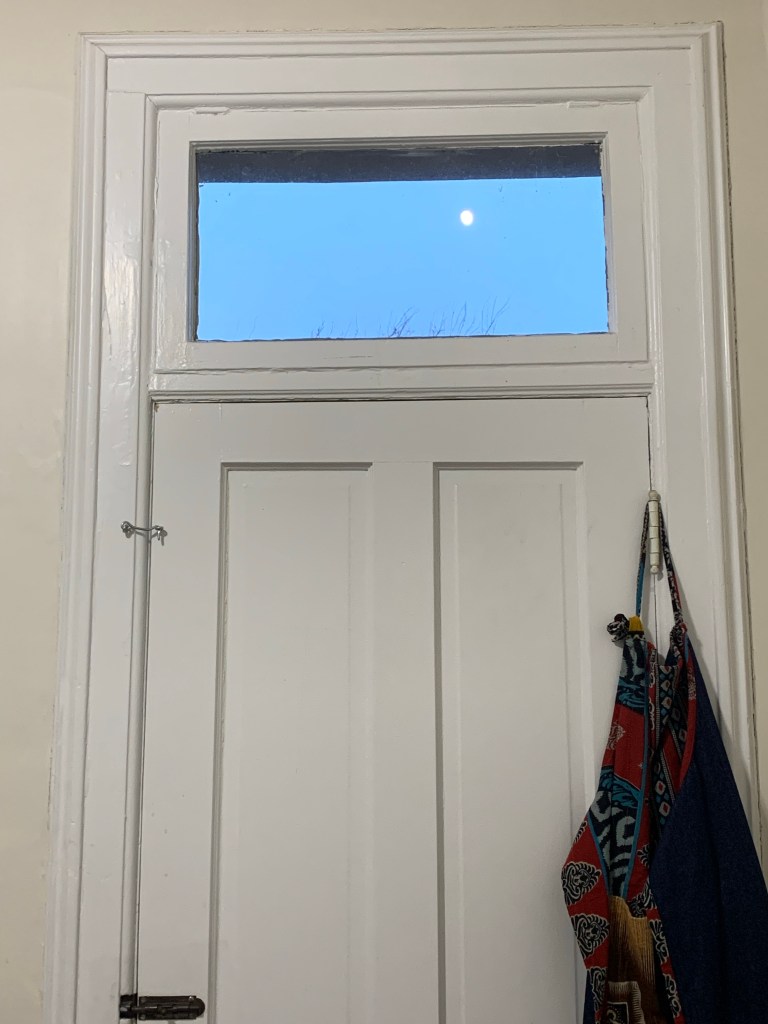
Last but not least, I am so grateful that despite living in the city where I can’t see the sunrise and sunset, I can witness the moon from our small kitchen window.
Alhamdulillah, last new moon as we entered Rabi’ al-Thani 1444 a new moon was born. We had a baby girl half past noon and we named her Zahra. Commonly translated as ‘flower’, it also means the exquisite and illuminated one. It was my first home birth and it reminded me of my second birth experience in many ways, from the fact that they were both born on a new moon, the general feelings around the pregnancy especially towards the end, length of pregnancy and how my labor started, how long labor lasted and the very intense, overpowering fetal ejection reflex (which was not as overwhelming with my other two daughters). Of course, this birth was a lot more hands-off having taken place at home (I recognize that’s not always the case even at home births), with no routine protocols set in place. I very much liked and enjoyed my midwife’s company during my pregnancy and while that did not guarantee that I would feel the same way at birth, I really appreciated her demeanor and support at birth too. After birth, everything went as smoothly as I could have wished for. The kids were ecstatic and they’ve been in love since.
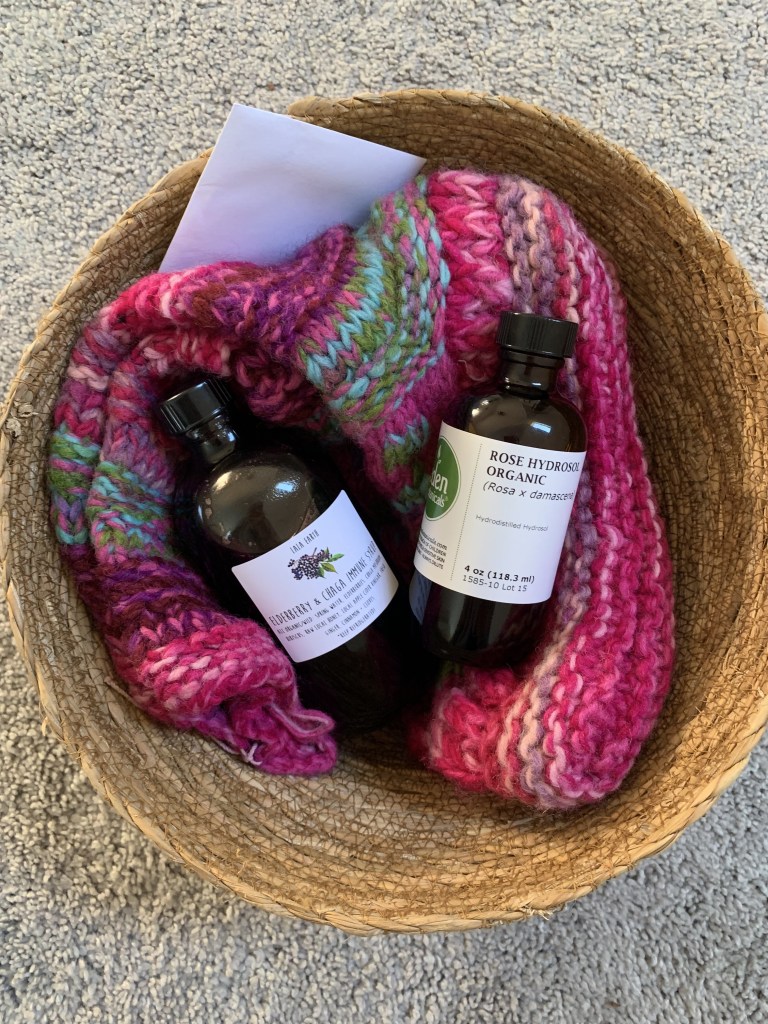
Gift basket for my midwife
As this pregnancy was the most I’ve been away from my family, with only one visit from my sister who had to leave before the birth, I really craved being cared for, something as simple as my mom or my grandmother making me a warming stew. I felt a void and yearned for a somewhat motherly nurturing. This might have been why I didn’t even want to meet a much younger midwife in my area after having met my much older midwife initially. It is also why I so appreciated the compassion I felt from a much older Ayurvedic postpartum doula and massage therapist whom I saw several times for prenatal massage. I almost felt bad getting that care from her and asked her once who cares for her. She said that she feels cared for by caring for others, and that when she gives a massage she has to remain as calm and grounded in her body as possible because tension in her body would translate to more tension in her client’s body.
While it’s been stressful in some ways, realistically speaking, it has also been a smooth transition overall and I have also gained a new appreciation for my husband. While this is not our first child and he’s always been there for each immediate postpartum period (with varying lengths), this is a new experience for him in that he’s had to take on a lot more responsibilities with no one else present to take them on. We also hired a traditional postpartum doula, a wonderful Mexican woman, for 4 days in the first week following birth. That was an invaluable investment and I would have hired her for even more days if it were feasible.
In the meantime I haven’t left the house in 2 weeks and I don’t plan to leave for as many days as possible in the first 40 days, especially not to go grocery shopping. While I miss taking the older kids out myself and getting on with my life as normal, I know that once this sensitive period is over I will be back at it inshaa Allah, so there’s no rush…
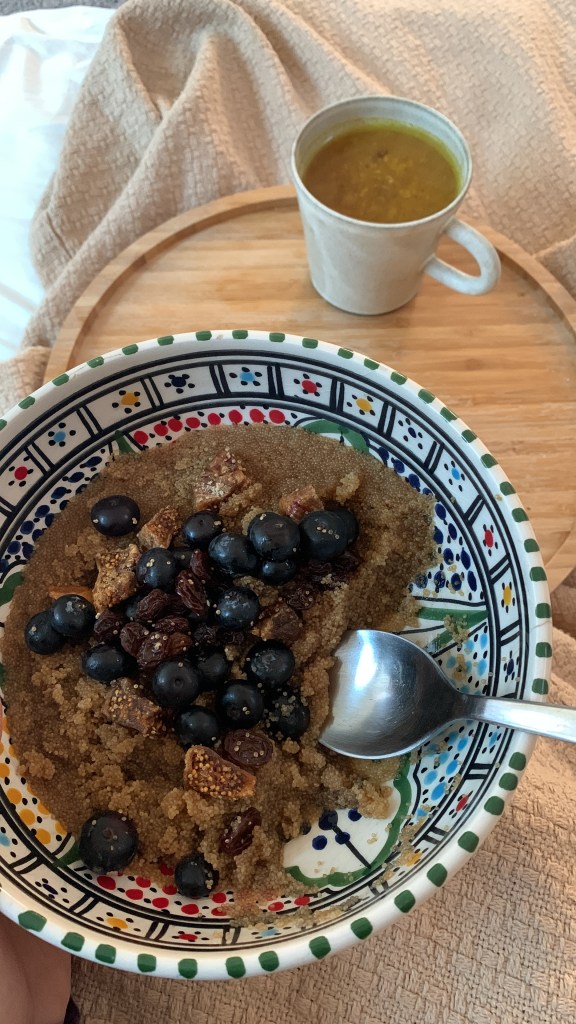
Breakfast in bed (amaranth porridge with fruit & golden milk made with coconut milk & chopped walnuts, prepared by my postpartum doula)
My first elimination diet of sorts was the Whole30 method. Even though I felt great for the most part while it lasted – except for the occasional and unusual tingling in my hands and feet possibly from oxalate overload from all that spinach – I can’t say it was a very successful endeavor because it fell apart after Day 17 (I attended an Iftar invitation and ate literally everything that was on the ”no” list in one evening), and once I cheated I couldn’t get back on the bandwagon. However, my terrible migraines and joint pain for the next few days left me with a lot of questions.
At this point, I didn’t know much about Prophetic nutrition (I still don’t) but I knew that Sayyidina Muhammad ﷺ liked and ate barley. So I decided that I was going to try some homemade barley flat breads without yeast for the next few days. My joint pain continued. I wanted to eat wheat bread again. Did he eat wheat? An article I found online said he did, but only occasionally. I couldn’t really verify. Another shaykh I respect said he never ate wheat. Possibly – perhaps barley was the staple food in their region at the time, and maybe Harissa, a dish that was suggested to the Prophet by Gabriel, was also prepared with barley grains rather than wheat grains. So why was my body responding with inflammation not just to wheat but also barley? Everything I bought was labeled organic. At least barley was a Prophetic food, and as far as I knew up until that point, I didn’t have any intolerance to grains, so what was the deal? I was mostly concerned with the grains at this point (I will get to milk in a bit) and I found many of the answers in Nourishing Traditions, as well as a little later in life through experience and other discoveries.
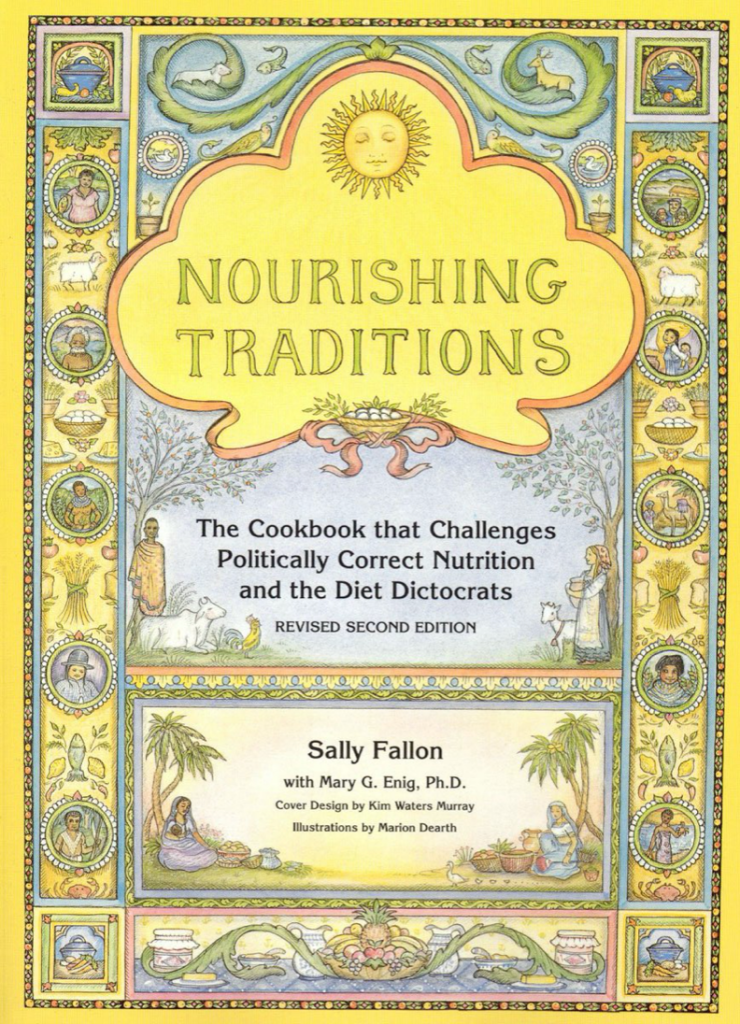
Nourishing Traditions Bookcover
I had bought the book Nourishing Traditions after hearing someone I admired mention it as a cherished book of theirs, but as you may know from personal experience, some things have to be learned at a particular time in life. So when I first bought this book, a while before trying out Whole30, it was overwhelming to me (maybe because I was adjusting to married life and a whole new country, trying to crochet multiple projects, trying to catch up with my herbal studies, educating myself about childbirth, and taking lots of naps with my cat all at once).
This was the right time to dig into the book. Parts of the book described what methods ancient traditions used to prepare as well as to preserve food and coincidentally or not, these methods also increased the bioavailability of the nutrients and made it easier on digestion. This made a lot of sense. With our fast-paced modern lifestyles, we were no longer preparing our foods in the same ways. I was excited to incorporate some of these teachings, especially soaking my grains including brown rice & oats for long periods of times before cooking in order to reduce the phytic acid content. Phytic acid is an anti-nutrient that inhibits the absorption of important nutrients. There is a misconception that whatever nutrients there are on a food label, our body actually absorbs in entirety. This is not true. A lot of that depends on the way the food is prepared, as well as your body (whether your microbiome is balanced as well as diverse.) A little off-topic, but much of our soils are depleted, not just from modern conventional agriculture that uses monocultures, poisons and synthetic fertilizers, but also from some organic farming as there is a lot more taking than giving back to the soil in the process of harvesting. Regenerative forms of agriculture on the other hand do not leave the soil depleted; regenerative agriculture enriches the soil (and mitigates climate change). This in turn yields produce that is of much higher nutritional content. In summary, not all e.g. tomatoes are created equal. (I highly recommend you watch the documentary Kiss the Ground on Netflix).
Fast forward, some other experiences after changing countries also taught me that not all wheat is the same. Nourishing Traditions does cover some older and superior wheat varieties, but I never gave it much thought until going off of wheat after having my second baby, and then wanting to re-introduce it. This re-introduction came after discovering einkorn which is the oldest type of wheat, and a re-emerging variety in Anatolia. I had tried cultivating a sourdough starter many years ago, before I even knew what sourdough was just because it sounded cool and it was supposed to be healthier, and gave up on it after my brother asked what that rotten sock smell was in the kitchen and I remembered that I had left it in a bowl on top of the fridge for way too long. Like I said, some things are better learned at the right time. I was ready to give it a second shot this time. I was thrilled watching the bubbles develop after each feeding every day, and my first sourdough einkorn bread was a delightful success. This bread was filling in small quantities, and did not cause bloating or any other digestive issues I experienced from other types of bread. My husband was also on the same page which made life a million times easier. Eventually I started incorporating other types of flour, but almost always heritage varieties, as well as barley and rye. And always sourdough.
Sourdough Einkorn & Barley
Around the same time, a friend of mine introduced me to the teachings of Aidin Salih, a pious Ukranian woman with a medical background who converted to Islam after studying Greco-Islamic Medicine. I can’t do her teachings justice in a few words but if I had to summarize it, her philosophy revolves around improving and protecting our health as well as our fitra (innate disposition) by choosing pure, nourishing foods and following sensible guidelines inspired from Prophetic and Qur’anic teachings. Despite the simplistic nature of her advice, it may seem very difficult to implement in our age, because of tainted food sources but mostly because of cultural beliefs and practices. Spending hours in the kitchen preparing a dish that has many steps and many ingredients is not prophetic in any sense and yet this is the case in most Muslim cultures.
To give a few examples, she advises that we should consume fruits before the main meal on an empty stomach as fruits are digested quicker than other foods such as grains and meats (very contradictory to the fruit platter that arrives right after dinner in a Turkish or Arab household). She also suggests that dairy and meats are not combined, very Kosher in practice, not obligatory in Islam but nevertheless a Sunnah. She suggests that different meats are also not combined, like chicken and lamb for example, as different foods require different enzymes, and this is burdensome on the digestion. She emphasized the importance of drinking living water. She is a strong advocate of frequent fasting, especially for those experiencing health issues. We have a fear that revolves around hunger. It seems contradictory to ‘starve’ an ailing person, but even recent findings or I prefer to call them re-discoveries are concluding the benefits of fasts on a body that needs a break from constantly digesting foods, and harmful inflammatory foods at that, in order to direct energy at healing. Unless you live alone most of the time or your entire family is on board, her advice is difficult to implement all the time. However, starting somewhere is better than nothing and I was very thankful to be introduced to her teachings. Sadly, she passed away several years ago. Nevertheless, her guidance continues to bear fruit and benefit many people.
O believers! Give from the good of what you have earned and of what We have produced for you from the earth. Do not pick out worthless things for donation, which you yourselves would only accept with closed eyes. And know that Allah is Self-Sufficient, Praiseworthy. (2:267)
I will never forget an experience I had many years ago. I attended a Mawlid event with a fundraiser, and there was a section of potluck dishes that were supposed to represent ‘foods that the Prophet liked’. With all due respect to everyone who contributed, no doubt with good intentions, nearly the entire table consisted of junk sugary products, because the Prophet liked ‘sweet foods’. It was disappointing as well as shocking to a degree. It made me wonder if these were truly fit to offer to the Prophet had he been amongst us. If I knew better then, I would have prepared something different, but my contribution to the potluck was couscous salad with dates and cucumbers. Initially I planned to prepare it with pearl barley but I was at a different event prior to the potluck, and cooking couscous was quicker than barley.
In cattle too, there is a lesson for you. We provide you from what lies in their bellies, between waste matter and blood, pure milk, palatable to those who drink it.
The Chapter of the Bee, 16:66
Amongst other foods that were liked by the Prophet is milk. Prior to deleting all of my social media, I came across a couple of accounts promoting in simple words the drinking of milk as a Sunnah and the benefits of milk. Going back to not all tomatoes (or wheat) being equal, similarly not all milk is equal, and not all cows are equal. There is a world of difference between the milk that comes from a heritage cow that happily grazes on green, living pasture and lives its life in a way that befits its innate nature with limited physiological and psychological stressors, and milk that comes from a hybrid cow that lives, or rather, tries to survive a torturous lifestyle under the oppression of human workers who treat them as a milk making machine, feeding them all sorts of garbage from GMO corn & soy to pesticide laden grains, pumping them with antibiotics and sometimes growth hormones. These cows never step a foot on grass. They live and die a sad life. Their milk is so lacking in nutrients that are otherwise found in real milk that it is then ‘enriched’ (just as refined wheat is) with synthetic vitamins. This milk doesn’t reach our tables in ways that befit prophetic conduct, it is not the milk the Prophet drank and it will not yield the same benefits, not physically nor spiritually. I could discuss honey as well, and why honey bought from conventional stores is best avoided as well as the large scale damage the honey industry is causing, but this will suffice for now.
Living in an urban area for the last few years with the convenience of grocery delivery, I asked my daughter not too long ago where the food came from, to which she responded ”Migros.” Initially I laughed, but then found it alarming. If you asked her a few more questions, she’d recall that food actually comes from seed and the soil, but it made me think of how our lifestyle made it very hard to experience that first hand. Our state as grown ups isn’t much different. We may be aware that milk comes from a mammal, but we should dig a little deeper when making decisions if we want to reap true benefit as well as cause the least amount of harm possible, to ourselves but also to animals and the earth, especially when we are claiming to follow in the footsteps of our Prophet ﷺ.
As my husband and I approach 7 years of marriage, I have been reflecting on some important lessons from our union. I also asked my husband a few nights ago what he has learned and what he values about our marriage. It’s nearly impossible to not mention the kids during our conversations, they are just a part of us now, but I am mainly going to stick to what concerns us two for this post.
A few years ago, I met an old friend for coffee. I can’t quite remember the exact question, but she asked me something on the lines of how to tell if someone is right for you. And I can’t quite remember my exact answer, but I remember not being content with it. I think I said something like… discussing some core expectations and values and see if they align. My husband and I did discuss core values and sort of what we pictured married life and raising kids to be like in the first couple of e-mails that we exchanged before moving onto phone calls, but that’s not the main way you can tell if someone is right for you. The truth is, no matter how certain you may think you are, marriage is a risk. There is even a possibility that if the marriage is wonderful the first few years, things can change at some point down the line and your paths may separate. There’s just no guarantee. You just have to make a mindful decision, and then pray for the best. So a few years later, I found myself still reflecting on what I would have answered this sister instead, and here’s what I think (in addition to your world paradigm being in alignment):
Gut feeling is important. If you have a healthy relationship with your parents and/or other family members, their gut feeling is important. How they treat you is important, but what is more important is how they treat others, so observation is key. A prospective spouse will most likely treat you well, at least at first, even if they are not genuine, but the way they treat others and especially their close kin will be a good window to their true nature. Asking some trustworthy community members, maybe some teachers, mutual friends or colleagues about their experience with the individual in question is a good consideration. You may think that you want someone who is God-fearing, and that them telling you they do their ‘rituals’, them dressing a certain way is a good way of knowing that but it is not. And if they use their supposed religiosity as a way to manipulate you, to make you feel like they are better than you, to make you question your self-worth, to make you feel bad about doing certain things while they get away with it (i.e. not for Allah’s pleasure but for themselves) or to act like you are already husband and wife before they even meet your family, you better turn around and run. Nip it in the bud.
My grandmother used to tell me that ‘akhlaaq’ (manners) comes before anything, and without manners, someone is not truly Muslim. That really stuck with me. I had the privilege of observing my husband before even meeting him, so I got a feel of some important behavioral habits he had (you might consider this a form of stalking but so be it!)
Of course we all have room for improvement, and to me life is an ongoing journey of becoming the best version of ourselves. So I am not saying that the individual in question will be perfect once you move in together if you feel that they may be the right person. However, some core manners and values, including being receptive to improvement will lay a strong foundation from which you can both grow together. I can see that both my husband and I have grown in many ways since we got married. We are not perfect, I don’t think we ever will be, but that’s OK because that’s not the point; we are perceptive of the ongoing journey. We value communication, and we practice self-evaluation. We have disagreements and we sometimes rub against each other in the wrong way, but we are mindful of respect, we are comfortable with apologizing if necessary, and we learned not to discuss anything until our minds have cooled down. Often when my mind is busy with something that is bothering me, or I am actually trying to pinpoint what it is that is bothering me, and my husband picks up on that, I affirm that I am indeed upset but I need some time before I can talk about it. He respects that, gives me space, and eventually we do talk about it.
Something that my husband stressed on for what marriage has taught him was that marriage, and having kids, changed his perception of the world and this life to a great extent. Having a wife and children made him recognize the value of family and connection. It also gave him an opportunity to see himself in a different light, that he would not have otherwise discovered had he not gotten married. This allows for further reflection and change.
I described to my husband that for me our union meant safety, not just physically but also spiritually. He told me that for him it was feeling supported. I also feel supported by my husband, and I am sure he would agree he feels safety through our marriage too, but with varying emphasis because of the nature of our relationship.
And of His signs is that He created from among yourselves mates that you may find tranquility in them; and He placed between you love and mercy. Indeed in this are signs for people who reflect. (30:21)
Life is often full of trials, from trivial every day things — requiring us to think twice before reacting — to much more significant events. I wouldn’t have wanted my marriage to be my main trial in life, but rather to be the safe haven from those trials and I believe that is what is intended for marriage by our Lord Most High. I am not trying to encourage divorce here before emphasizing on the importance of trying to sort things out with your spouse through healthy and honest dialogue and even therapy if there is some work that needs to be done (except for cases of abuse and manipulation which shouldn’t be tolerated) but divorce is halal in Islam for a reason. Sometimes couples just do not click, even if both sides are good people, and sometimes the issue at hand is more grand. Marriage should be a means of growth, elevation, comfort and serenity, not suffering, and you should be able to experience the pleasures of life together with your spouse. Alhamdulillah, I feel just that through my marriage that began with simplicity and with honesty, not just towards each other but towards Allah.
As a final note, this is by no means a message to my single brothers and sisters that to have any self-worth, growth or valid aim in life they must be married. I recognize this is a sensitive issue, especially because of cultural pressure on single people to get married (usually for the wrong reasons) so I don’t want to add salt to injury.
Actually, this reminds me of something that I want to add… one time my brother asked my mom if I ever regret marrying and having children so early, and my answer is: no, not at all. However, I do regret all the time I wasted before marriage. So all you singles out there, enjoy all the time and freedom you have, but be mindful of it!







 Solicitous Home