
Eleven & a half years on

I saw this viral video a couple of times, a Kurdish family, the daughter is surprising her parents with deciding to wear hijab. It seems, from the few words her father uttered, that there was initially a dispute, or that the daughter struggled before finally deciding to veil. The parents are emotional, the mother is crying & praising God, and I found myself getting goosebumps and tearing up too.

This is so different from my personal experience when I decided to wear the hijab, a few months after graduating from high school. I always imagined that I would eventually veil, but I didn’t expect it to be as soon as starting university. Alhamdulillah, the last minute decision to enroll in an Islamic Sciences faculty in Istanbul where boys and girls were split and 99% of the girls were veiled made it a natural decision. I was already wearing it on my first week before classes, while strolling through the different neighborhoods, hopping on and off buses, and getting lost a couple of times.

I am sure a lot of girls who decide to wear the hijab are often told that they are not ready for it. That was precisely my experience. I struggled a lot in the first year because societal pressure was so clearly felt every time I visited Cyprus, with no encouragement from my closest ones. Come to think of it now, my parents were dealing with other things. I was not really on their radar and list of priorities, to help their eldest daughter try to fit in to a problematic society better without having to sacrifice a religious obligation she was trying to maintain. My father did once acknowledge the struggle, when I attended a relative’s wedding with him and I was the only one wearing the hijab in addition to an old Turkish teyze sitting on the other end of the ballroom. I will never forget that.

I felt so free in Istanbul, switching between two simple abayas and wrapping around my matching black scarf, not having to think twice what anyone would say or think, and then coming to Cyprus — an island where visibly practicing Muslims at least at the time could be counted on one hand — not knowing what to wear to stand out less, how to react at the sight of an old classmate and how to answer the questions of prejudiced islanders and uncultured relatives.

~ * ~ * ~ * ~

My daughter is turning 8 in about two weeks. Some time ago, we were rushing out to her karate class and she decided to walk out with her instant hijab. I caught myself telling her that she should take it off. I stopped in my tracks at the realization that I was projecting the remnants of my own insecurities onto her. I quickly changed my tone and told her she could wear it to class, not allowing my own insecurities to taint her innocence and self-esteem. No one said anything to her in class, and she took it off anyway 5 minutes into their warm up, and we continued our day as normal with none of my personal trauma being passed on. I know that when she reaches the age of accountability, I will be encouraging her in her hijab journey, helping her work through any concerns related to self-esteem. I will help her style her hijab and pick out appropriate yet appealing outfits.* How could I discourage a command from Allah, a sunnah of the daughters and wives of our Prophet, if we believe it to be as such?

I think there is this underlying assumption especially when it comes to the hijab, that there are things we have to do before we wear the hijab. My spiritual journey did not conclude on the day I decided to veil for good. I did not all of a sudden become the best version of me. Likewise, when we pray our fardh prayers, we are not on cloud nine every single time. We have to be actively mindful, at every prayer time, that we are standing and prostrating to the Most High, renewing our covenant with Him. It is a struggle. Even though I don’t struggle with self-image nearly as much as when I first decided to veil 11 & a half years ago, I still have to proactively avoid getting influenced by social media (including what are called hijabi influencers), the desire to ‘make a statement’, and regularly renew my intentions as to why I am observing hijab. In addition, I have to be mindful that I am a representative and my actions need to be in line with what I am aiming to represent.

Similarly to Salaah, it is fair to say that, when done with the right intentions and mindfulness, covering our ‘awrah and observing the hijab will protect us from prohibited acts. It will not happen overnight, but it will be helpful, especially if we are not discouraged because we aren’t yet saints doing everything else we should be doing or 60 years old. Hijab is not the cherry on top.

One piece of advice that I think personally has helped me in my journey is that when I am feeling creative, surrounding myself with righteous people, doing acts of service, reading frequently and doing other things that I love doing, I feel less concerned about what my looks will mean to the outside world. Because I feel mentally and spiritually empowered, I don’t seek empowerment by other means that would interfere in proper hijab. For all my sisters struggling with the hijab, remember that you are doing it for the sake of the Most High. When you look in the mirror as you are covering, believe that what you are doing is beautiful because it is for a higher purpose.

* Even though our daughter is not yet at the age of accountability and does not need to wear the hijab, we are still mindful of what she wears, avoiding revealing and tight clothing, as a means of protection for her and also to make veiling easier for her once it will be expected of her.
Raw Motherhood

I am a mother of three as of recently, and I frequently get asked how it is managing three young children. The assumption is that the more of them there are, the harder it gets. That’s true in some ways. However, I would argue that having one was harder for me.

Usually when I put the kids to sleep, the arrangement is as follows:

I co-sleep in a single bed with 1-month old Fatima, 2 year old Abubakr is in a crib with the narrower side attached to my bed, and 3.5 year old Zaynab is in the other single bed beside mine and she usually sleeps with her aunt.

This will change once I go back to Istanbul to our own home but for now while my husband is away in the US and I’m with my family in Cyprus, our arragenment is as such.

Tonight, the arrangement was slightly different. Their aunt was busy so she didn’t participate in the bed time ritual (which includes story telling and then a semi-long religious litany and waiting for all the kids to sleep before sneaking out of the room). Fatima happened to be asleep downstairs in the living room. So Abubakr, who is always eager to sleep beside me instead of the crib, lay next to me and Zaynab laid down in her own bed. By the time I finished the litany, Abubakr was asleep. Zaynab by that point asked me to sleep next to her, so I did. I whispered some more litanies, and she fell asleep facing me, with her hand in mine. In the meanwhile, I began reflecting on something that I frequently remember: how much harsher I was to her as a younger toddler in comparison to her brother. It kills me because I can’t ever undo those moments. I never realized in those moments how small she was, how vulnerable, fragile. I only realized as she grew older and I could compare her to her younger brother. When I had my first child, everything changed. Everything. And probably for good. I was no longer able to do very basic things on my own without having to put another person into account. There was now this human being who literally depended on me for survival. Add to that insufficient socialization with other humans and lack of support. I won’t forget this one time at nap time where she was 13 months old, and I was about 4 months pregnant. I was nursing her and hating every minute of it because I couldn’t stand physical touch during pregnancy. She was taking a long time falling asleep – you have to understand, nap time and night time is like your time off – and I just lost it. I started yelling at her, telling her to shut her goddamn eyes and handling her very roughly. Imagine someone is hugging you and then all of a sudden they start to give you a rough shake. (Makes me sick of myself just thinking about it). Still half-nursing, she began crying, obviously. It was a painful cry. She must have been so confused. I don’t remember the details but I think she fell asleep finally because I remember quietly walking out of the room and hugging my husband who was approaching me in the hallway and I broke down crying because of how horrible I felt about having lost control of myself and hurting this child that I would die for. That’s when I decided I had to wean her because I didn’t want to feel resentment during an act that’s supposed to be an act of love and nurturing. My point of mentioning this is not about how pregnancy makes you feel sensitive or whatever and how you should handle those feelings. The issue here was not simply that. These types of moments were the result of a build up of underlying emotions, exhaustion, lack of support, lack of spiritual and physical nourishment. A lot of possible issues. And of course lack of understanding on how to deal with this little human being, because it was my first time and my life was forever changed. I had so much more patience with my second child in comparison to my first – maybe because we had a different structure as a family with where we were at in our life, having moved closer to my family, taking care of myself better and so on – but I think having had that experience already and this second child not making my already-mom life a whole lot more different played a major role too.

I’m never going to not feel regret over those ignorant and weak moments and I can’t help but think of how painful and possibly scary it must have been for a little child whose entire life revolved around me but I find comfort in that those moments didn’t and don’t make up the majority of my child’s upbringing. She is loved; she knows it and she feels it. Children are also incredibly forgiving, which is painful to think about, yet heartening.

I want to wrap up by mentioning two things:

A while back, I read something that really stuck with me. I don’t remember the author or where I read it, but it was about the most impactful moments in a child’s day. How they wake up, or rather what they wake up to, their nap time, and their bed time. So I try to really be careful in those moments (not that they nap anymore); to really be present with them, not to be caught on my phone the moment they wake up, greeting them with enthusiasm, kissing them, using a gentle tone, and likewise in the evening. In other words, making them feel safe and look forward to the day and the next day.

Finally… I read this hadith today which I had read before but hadn’t ever really reflected on and intended to act upon:

Narrated by Abu Dharr, the Messenger of Allah (ﷺ) said to us: When one of you becomes angry while standing, he should sit down. If the anger leaves him, well and good; otherwise he should lie down. (Sunan Abi Dawud)

Let’s be real. I still get angry from time to time and snap at the kids, especially on stressful days. So inshaa Allah, my intention is to remember the advice of our Prophet next time I feel my anger may overcome me.

.

.

.

See you tomorrow.

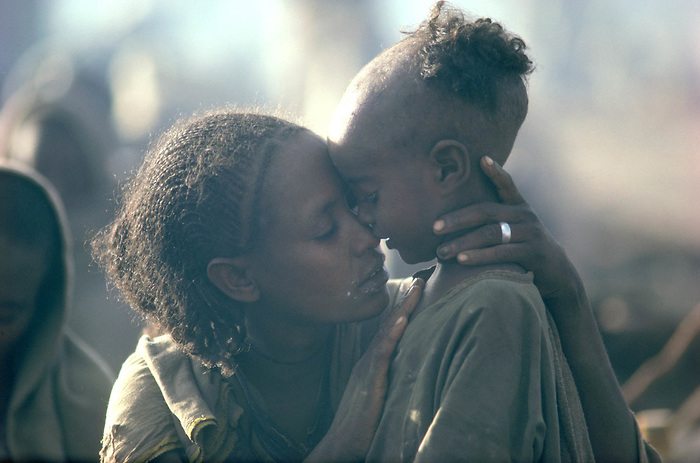
BUR8411-EthiopiaMotherLR
© David Burnett –  Ethiopia 1984

Spirituality, in the Kitchen

Intention is an integral part of Islamic practice. In the first hadith that is mentioned in Imam Nawawi’s famous compilation of 40 hadiths, the Prophet Muhammad ﷺ is narrated to have said: ‘Actions are only by their intentions.’

As a general rule, obligatory religious acts require a specific intention (such as what time of prayer is about to be offered) whereas voluntary religious acts can have multiple intentions. Without intending ritual prayer, one’s prayer is not valid. Likewise in some schools of thought, taking ritual ablution requires intention. When fasting in Ramadhan, one must intend to fast prior to the entrance of dawn. As for voluntary acts of worship, for example, one can intend to offer two voluntary rak’ahs of prayer to show gratitude towards Allah, for a safe & blessed day and for forgiveness. Likewise, any act in our daily lives outside of obligatory religious acts can be carried out with a multitude of meaningful intentions. Islam is not simply the five pillars. Intentions add meaning to our lives. We can eat simply to be satiated, or we can begin to eat by mindfully reciting the Basmala, with our right hand to follow the Sunnah, with thankfulness and with the intention that we will use the energy provided by this meal to carry out good. What a big difference.

As a stay-at-home mother of two, I try to be mindful of what my intentions (or goals, really) are in many decisions I take in my daily life. However, because a big portion of my daily routine is spent in the kitchen, there’s a lot of intentionality that goes on inside this small space. Intentionality can be applied to any part of your daily routine, so if the kitchen is not your primary hub, you may still apply this to other parts of your life.

I know that spending long hours everyday in the kitchen, or tidying up, raising children from the morning till the evening (and in the middle of the night), being at everyone’s service, can sometimes have you question whether you’re doing anything meaningful or not. At least I’ve been there. This seemingly never-ending house work that keeps repeating itself every time you think you’re done with a chore. I am all for getting help as needed and taking a break every now and then. However, on your day-to-day life, intentionality will keep you from the unhealthy & deceptive feeling that you’re not doing anything worthwhile.

I didn’t want to keep this post long and I feel it’s already gotten long so I am going to jump right into some actions you can implement in your cooking area! I want to just begin by mentioning wudhu (ablution; ritual purity). Only Allah knows all the merits of being in a state of wudhu and its reality, but it clearly holds an important place as per the hadith of the Prophet where he describes angels accompanying the person who goes to sleep in a state of ritual purity until he awakes. I understand the difficulty this may bring, especially for mothers who barely have time to go to the bathroom, let alone take their time to take wudhu when it’s not prayer time but I urge you to try to at least implement it for some meals, with mindfulness, that you are intending to cook with wudhu and intend for the benefits of this state to manifest in your food. If you follow me on Instagram, you know that I’ve been baking my family’s bread for the last few months now. Ever since I began, I try my very best to remain in a state of wudhu while feeding my sourdough starter, kneading the dough and baking the bread. I try to remain in this way when I do my other cooking, as well as while eating. Ladies who are on their moon cycle may consider taking a symbolic wudhu, with the intention of receiving the spiritual benefits of wudhu without resuming ritual acts of worship. In addition to having wudhu, I recite al-Fatiha while I stir my sourdough starter during a feed, or salawat while cooking as I remember, and when I bake a bread for a friend or cook a meal for my family, I intend for that food to bring healing, physical as well as spiritual wellbeing and give thanks for it. If you believe in spirituality, you most likely understand how our feelings and energy can have a strong impact on what they are directed at. While cooking, whether just for yourself or for others, avoid all unhealthy thoughts and feelings to the best of your ability. If you find your mind roaming to undesirable territory, try to refocus and renew your intentions. Trust me, you don’t want yourself or your loved ones to eat food that was prepared with negative energy. (Who knows what state meals might have been prepared in in restaurants!). Try to include Prophetic foods in your diet. I highly suggest Zainab Ismail if you want some ideas and inspiration on how to do just that, very easily. Learn about the sunnan of eating and implement them with the intention of following the Prophet’s way. He ﷺ did not pick certain foods or eat a certain way simply out of desire but because they are superior and better for us.

As a side note: if you feel like you can’t focus in the kitchen for the life of you, consider what state the kitchen might be in when you’re trying to make a meal. Is it unorganized, cluttered, and you don’t know where is what? Maybe that’s a good place to start!

For the stay-at-home mom… If you are in charge of your kitchen, you are actually in charge of your family’s wellbeing. Your spiritual state in this territory will impact the physical & spiritual wellbeing of your spouse, children and/or other family members. The meal cooked with love, du’a and with mindful intentions will nourish your family and so, their accomplishments within their own duties and responsibilities will be connected to the nourishment you are providing them with. That’s a big and praiseworthy role, if you ask me. So next time (and if ever) you feel down about ‘wasting’ ‘all your time’ in the kitchen, think of this.

IMG_1011
Sourdough Einkorn Bread


I hope & intend that you find benefit in this post!